Frequently asked questions
Questions about CREXONT? Here are some answers
Limitations of IR CD/LD
What are the limitations of immediate-release carbidopa/levodopa (IR CD/LD)?
IR CD/LD has been the standard of care for treating Parkinson’s disease (PD) for many years—it’s designed to work quickly but may wear off quickly too. Over time with IR CD/LD, the duration of your symptom control may become more unpredictable, and you may experience more “Off” time and require more frequent dosing throughout the day. In fact, about half of patients taking a PD medication may experience “Off” episodes within 2 to 3 years of being on treatment.
Speak with your healthcare provider if you notice more “Off” time or changes in how your medication is working.
How CREXONT works
How is CREXONT different from other carbidopa/levodopa (CD/LD) treatments?
CREXONT is an extended‑release form of CD/LD that uses a unique technology designed to gradually release levodopa in the part of the gut where it is best absorbed, although the exact site and duration of absorption is unknown. In a clinical pharmacology study, CREXONT maintained levodopa levels longer than other available oral CD/LD options (IR CD/LD and RYTARY).*
Speak with your healthcare provider if you are considering different CD/LD treatment options, and want to see if CREXONT is right for you.
*Based on the time LD plasma levels were maintained above 50% of Cmax.
What makes CREXONT’s extended-release (ER) technology different from other oral carbidopa/levodopa (CD/LD) medicines, like RYTARY?
CREXONT uses a novel ER technology that includes immediate-release (IR) granules and ER levodopa (LD) pellets inside the capsule. The IR granules dissolve quickly, while the ER LD pellets help maintain levodopa levels for a longer period of time.
CREXONT’s unique ER technology is designed to work in three ways:
- Delay breakdown of the medication
- Help the medication remain in the area of absorption longer*
- Gradually release levodopa over time
This allows CREXONT to maintain levodopa levels longer than IR CD/LD and RYTARY in people with Parkinson’s disease.
Speak with your healthcare provider to see if CREXONT is right for you.
*Exact mechanisms and sites of absorption are unknown.
What is dyskinesia?
Dyskinesia happens when your medicine is working, but the level of levodopa is too high and you may experience movements you can’t control.
What is the difference between “Good On” time and “On” time?
“Good On” time is when your medicine is working, and you are not experiencing dyskinesia or it is not troubling you.
“On” time is when your medicine is working and your symptoms are well-controlled, but you may be experiencing troublesome dyskinesia.
What is “Off” time?
“Off” time is when your medicine is not working and symptoms return.
Results with CREXONT
How can CREXONT help with “Good On” time?
In a clinical study, CREXONT provided more “Good On” time with fewer doses per day compared to IR CD/LD. People who took CREXONT an average of 3 times a day achieved 30 minutes more “Good On” time per day than those taking IR CD/LD an average of 5 times a day. *†
Speak with your healthcare provider if you are noticing changes in your “Good On” time or are interested in less frequent dosing to see if CREXONT is right for you.
*“Good On” time is defined as “On” time without troublesome dyskinesia. Change in “Good On” time was measured by comparing values at the end
of study to baseline; P=0.019 vs IR CD/LD.
†This was the average dose frequency during the double-blind maintenance period.
Can CREXONT help reduce “Off” time?
In a clinical study, people who took CREXONT had 30 minutes less “Off” time per day compared with those who took IR CD/LD.*†
Speak with your healthcare provider if you are experiencing “Off” time or changes in how your medication is working to see if CREXONT is right for you.
*This was a secondary endpoint of the study.
†Study end=Week 20 or early termination; P=0.0252 vs IR CD/LD.
How long do the benefits of each CREXONT dose last?
In a different analysis of the pivotal clinical trial, people taking CREXONT experienced 1.6 more hours of “Good On” time per dose compared to people taking IR CD/LD.*†
Speak with your healthcare provider if you are looking for a longer duration of benefit for each dose to see if CREXONT is right for you.
*“Good On” time is defined as “On” time without troublesome dyskinesia.
†This was a post hoc analysis of the study; P<0.0001 vs IR CD/LD.
What other research has been done on CREXONT?
CREXONT is also being studied in a Phase 4, open‑label trial looking at how CREXONT works in the real‑world for people switching from other oral levodopa therapies like IR CD/LD, IR CD/LD with a catechol-O-methyl transferase (COMT) inhibitor, and RYTARY. *
In an interim analysis of the first 111 patients that completed 6 weeks of treatment with CREXONT, patients experienced:
- An increase of 3.3 hours of “Good On” time per day
- A decrease of 3.1 hours of “Off” time per day
- 4.1 hours of “Good On” time per dose†
Speak with your healthcare provider to see if CREXONT is right for you.
Other oral therapies include immediate-release carbidopa/levodopa (IR CD/LD) (with or without a bedtime dose of controlled-release CD/LD), IR CD/LD plus a catechol-O-methyl transferase (COMT) inhibitor, or RYTARY.
*Other oral therapies include immediate-release carbidopa/levodopa (IR CD/LD) (with or without a bedtime dose of controlled-release CD/LD), IR CD/
LD plus a catechol-O-methyl transferase (COMT) inhibitor, or RYTARY.
†“Good On” time per dose was defined for a 3-day Parkinson’s disease diary as the total duration of “Good On” time over all valid days in the diary
divided by the total number of doses taken during those days.
Who is CREXONT right for?
Can I take CREXONT if I have not taken Parkinson’s medications before?
CREXONT can be used at all stages of Parkinson’s disease. This includes people who have never taken treatment before (treatment‑naïve), those who have been treated previously with a different formulation of CD/LD, those with early Parkinson’s disease, and those with more advanced disease.
CREXONT is approved for adults with Parkinson’s disease, post‑encephalitic parkinsonism, or parkinsonism caused by carbon monoxide or manganese exposure, so any adult with one of these conditions may be eligible for treatment.
Speak with your healthcare provider if you are newly diagnosed or considering a change in your treatment plan to see if CREXONT is right for you.
If my symptoms are controlled with immediate-release carbidopa/levodopa (IR CD/LD), could CREXONT still be an option?
If you are currently taking IR CD/LD, controlled‑release CD/LD, or any other CD/LD formulation, including RYTARY, you may switch to CREXONT and could potentially benefit from less frequent daily dosing.
Speak with your healthcare provider if you are considering a treatment change and want to see if CREXONT is right for you.
Can I take CREXONT if I am taking a catechol-O-methyl transferase (COMT) inhibitor?
Yes. CREXONT can be used if you are already taking a COMT inhibitor, such as entacapone or ONGENTYS. Your healthcare provider may keep you on your COMT inhibitor, or they may ask you to stop taking it when starting CREXONT.
Speak with your healthcare provider if you are taking a COMT inhibitor and wondering how switching to CREXONT might affect your treatment plan.
Starting CREXONT
Does CREXONT reduce total daily dosing frequency compared with immediate‑release carbidopa/levodopa (IR CD/LD)?
In a clinical study, CREXONT provided more “Good On” time with fewer doses per day. People who took CREXONT an average of 3 times a day achieved 30 minutes more “Good On” time per day than those taking IR CD/LD an average of 5 times a day.*†
CREXONT is also the only oral CD/LD formulation approved for twice‑daily dosing, and can be taken up to 4 times per day, giving flexibility to meet your individual treatment needs.
CREXONT dosing is based on your total daily levodopa dose and your most frequently used single levodopa dose.
Speak with your healthcare provider to see if CREXONT is right for you.
*“Good On” time is defined as “On” time without troublesome dyskinesia. Change in “Good On” time was measured by comparing values at the end
of study to baseline; P=0.019 vs IR CD/LD.
†This was the average dose frequency during the double-blind maintenance period.
What is the recommended starting dose frequency for CREXONT?
CREXONT is the only extended‑release carbidopa/levodopa (ER CD/LD) formulation that may be taken as little as 2 times per day, and can be taken up to 4 times per day, depending on your needs and previous treatment.
Speak with your healthcare provider if you have questions about how often you should take CREXONT or whether twice‑daily dosing may be an option for you.
How do I know if an adjustment in dose strength or frequency of CREXONT is needed?
Your healthcare provider will follow up with you within 1–3 days after starting CREXONT. During that time, your CREXONT strength or dosing frequency can be adjusted based on how you are responding to the medication.
Speak with your healthcare provider if you are taking CREXONT and notice changes—good or bad—in how you feel.
How do I know if I am “wearing off”?
“Wearing off” happens when your Parkinson’s symptoms return before it is time for your next dose of medication.
Speak with your healthcare provider if you are experiencing “wearing off” on your current treatment.
Can CREXONT dosing be individualized?
Yes. CREXONT dosing is individualized based on your current treatment plan, how well your symptoms are controlled, and other personal factors.
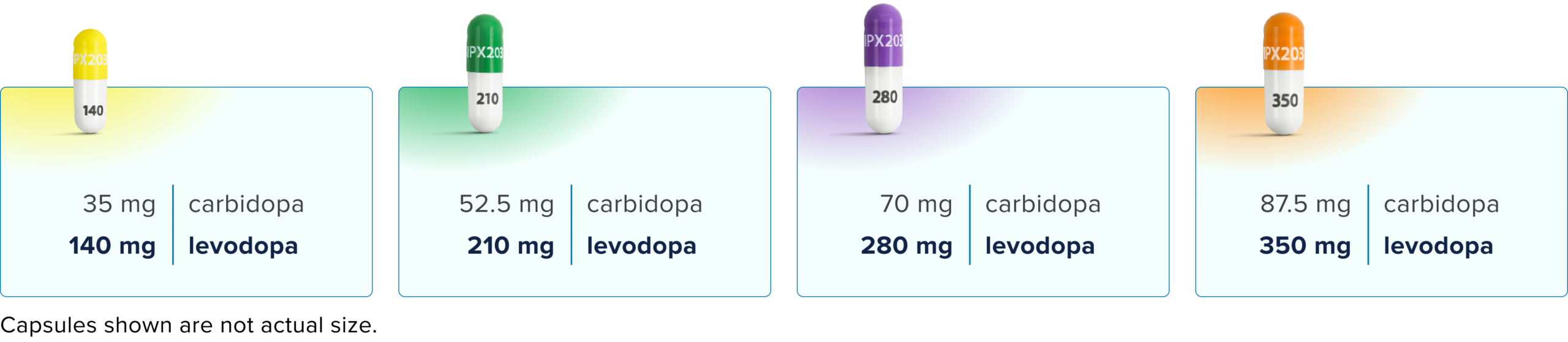
CREXONT comes in 4 different strengths and can be taken 2 to 4 times a day. The maximum recommended daily dose is 525 mg of carbidopa and 2100 mg of levodopa.
Speak with your healthcare provider if you have questions about what CREXONT dose or schedule is right for you.
What is the maximum recommended daily dose of CREXONT?
The maximum recommended daily dosage of CREXONT is 525 mg carbidopa/2100 mg levodopa.
Speak with your healthcare provider if you have questions about your CREXONT dose.
Can I stop taking CREXONT if needed?
Speak with your healthcare provider before stopping CREXONT. Discontinuing CREXONT should be done slowly. Speak with your healthcare provider right away if you experience any withdrawal symptoms, such as fever, confusion, or severe muscle stiffness.
Can I take CREXONT with other Parkinson’s disease (PD) medications?
In a clinical study, many patients used CREXONT along with other PD medications. At the start of the study, about 73% of patients in the CREXONT group and 63% of those in the immediate‑release carbidopa/levodopa group were taking at least 1 additional type of PD medication. These medicines were continued as long as doses had been stable for at least 4 weeks before the study began.
CREXONT can be taken with other PD medications; however, it’s important to review a comprehensive medication list with your healthcare provider to determine if there are any drug interactions.
Should I track motor symptoms when starting CREXONT?
Tracking motor symptoms with a diary can help guide dosing and timing based on when you experience “Good On” time and “Off” time. Using a symptom tracker can support this process and help you and your healthcare provider understand how the medication is working for you.
Speak with your healthcare provider about using a symptom diary or tracker to monitor your daily patterns.
Can CREXONT be taken with food?
You may take CREXONT with or without food, but taking it with food may decrease or delay its effect. Consider taking the first dose of the day about 1 to 2 hours before eating.
Swallow CREXONT whole. Do not chew, divide, or crush the capsules.
Do not take CREXONT with alcohol.
Speak with your healthcare provider if you are unsure how meals might affect your treatment.
Can CREXONT be taken with iron supplements or multivitamins?
Iron supplements or multivitamins that contain iron can bind to levodopa and carbidopa. When this happens, it may reduce how much of the medication your body absorbs, which can make CREXONT less effective.
Speak with your healthcare provider if you take iron supplements or multivitamins with iron to avoid interactions and keep your symptoms well‑controlled.
What should I know before taking CREXONT?
Your doctor should evaluate vitamin B6 levels before and during treatment with carbidopa/levodopa therapies as seizures associated with low levels of vitamin B6 have been reported. Traditional anti-seizure medications were not effective, and seizures were only resolved after vitamin B6 administration.
Speak with your doctor if you experience seizures or other symptoms of vitamin B6 deficiency including depression, confusion, cracked corners of the mouth, swollen tongue, skin inflammation, low red blood cell count, and/or numbness, tingling, or weakness in the extremities.
Safety
What are the most common adverse reactions?
The most common adverse reactions with CREXONT (occurring ≥3% and greater than immediate-release carbidopa/levodopa) are nausea and anxiety.
See full Important Safety Information below.
Speak with your healthcare provider if you notice nausea, anxiety, or any new or worsening symptoms while taking CREXONT.
